The Delectable Palette of Starbucks’ Italian Picks

Updated: Aug 7
The infusion of Italian cuisine has been a staple in the Philippine culinary scene. In fact, restaurants like Greenwich, Pizza Hut, and Shakey’s have been part of the lives of millions of Filipinos for about seven decades. Actually, Greenwich is the only Philippine-based pizza chain among the three brands I mentioned earlier. Moreover, it is not a standalone company; it was founded right at the Greenhills Shopping Center back in 1971. At present, Greenwich has been part of the umbrella of the Jollibee Foods Corporation since 1994, and has expanded to hundreds to thousands of branches nationwide. Shakey’s and Pizza Hut emerged in the United States in 1954 and 1958, respectively. When the 1970s and 1980s arrived, the two internationally recognized pizza brands (respectively) found themselves an abode in the Philippine market. In fact, San Miguel Corporation catalyzed the introduction of the Shakey’s brand to Filipino appetites in 1975. Eventually, Shakey’s liberated itself from San Miguel’s corporate arms and proceeded to define itself as part of the Century Pacific Food family—the manufacturer of Century Tuna, Birch Tree Full-Cream Milk, and 555 Sardines.
Starbucks, as people are accustomed to, is a coffee empire that has been expanding worldwide. However, it began as a humble coffee shop right across the streets of Seattle, Washington State, in 1971. The Pike Place Market was proclaimed its first worldwide branch, paving the way for other American and international branches to commence their operations. Gordon Bowker, Jerry Baldwin, and Zev Siegl were catalysts in carving the name of this internationally renowned coffee company in the fast-paced consumer goods industry. Not living up to the expectations of customers, these founders were not exactly veterans of the brewing industry. Instead, they were part of the academe that centered on the liberal arts. Baldwin and Siegl served as English and history educators, respectively, who had immense respect for the power of activating learners’ minds in the rigors of prose and poetry composition, reading comprehension, and historical studies and analysis. On the one hand, Bowker was a dedicated author who published books like James Joyce: A Biography and George Orwell. Driven by their desire to erect a name for themselves in the coffee bean business and to fuel their passion for serving fresh brews and pastries, the three young men tapped Alfred Peet to perfect their coffee and tea formulations. Peet originated from the Netherlands and found himself a home in the United States. In the 1950s, years after the conclusion of World War II and the restoration of the new international order, he relentlessly pursued his passion for serving coffee cups nationwide. This was initiated via purchasing imported arabica beans, leading him to open his very own coffee shop—Peet’s Coffee and Tea—in the succeeding decade. Recognizing the potential investment returns on procuring high-quality coffee beans and tea leaves to create brewed beverages, the Starbucks founders partnered with Peet to acquire the needed coffee beans and tea leaves to invigorate their customers in the morning and provide relaxation after a heavy meal in the afternoon and evening. Sixteen years after Starbucks’ founding, Howard Schultz purchased Starbucks’ shares from the three founding fathers and proceeded to expand it into the global brand it is today.
In 1997, the Philippines welcomed Starbucks into the domestic coffee market, with its inaugural branch situated at the prominent 6750 Ayala Avenue building in Makati City. Before this happened, the Philippine coffee industry was dominated by local brands like Figaro Coffee, Bo’s Coffee, and Cafe Adriatico. They were successful in providing the expected ambiance of a work and leisure environment of a coffee shop, and sharing its menu of warm and cold beverages and pastries. However, their market footprints were mostly confined to the Philippines. When Starbucks entered the Philippine caffeine arena, this notion changed by providing an international perspective in producing the highest quality of coffee, tea, and frappuccino selections. Other than these staples, its branches offer delectable meals and pastries like pastas and chocolate-filled croissant bread (famously known as pain au chocolat). This enterprise is wholly owned by the Rustan’s Group of the Tantoco clan and has been expanding across all regions in the Philippines. Expansion is an instrument for the company to expand, making it accessible for loyal Filipino customers to indulge in the aroma and texture of these products.
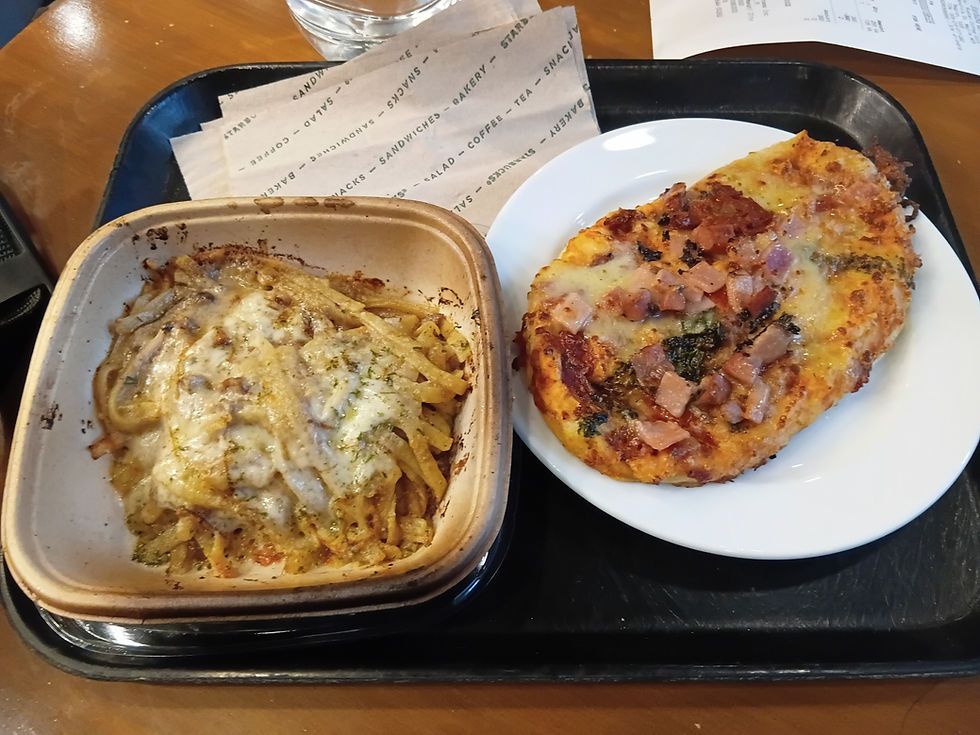
Roasted chicken pesto (left), sausage and bacon flatbread (right) are the featured meals in the above photo. The former is a combination of delectable roasted chicken slices and mushrooms, dressed with shiitake sauce for a creamy taste and texture. In particular, the sauce itself is the major contributor to making this pasta dish enjoyable to consume at any time of the day. It contains rich ingredients like soy and oyster sauces, which add sophisticated and rich flavor to the dish itself. On the one hand, the flatbread is a direct inspiration of the world-famous pizza, particularly its meat-filled variants. Just imagine the bacon and sausage pizzas you usually order at Greenwich, Domino’s, and Shakey’s, and this will make sense to you. Instead of offering the traditional circular-shaped pizza, Starbucks strives for mobility and pastry-level sizing by making its pizza-oriented offerings easy to carry and ingest. That’s where the term flatbread came into fruition, which is intended to be the bridge between regular pizzas and the well-loved breads that Filipinos and foreigners enjoy (e.g., ensaymada, chocolate croissant).
On July 5, 2026, I headed to the nearest Starbucks branch to the Centro Escolar University (CEU) and La Consolacion College (LCC) in Mendiola, Manila, after taking the mentally grueling Japanese-Language Proficiency Test (JLPT). There were thousands of candidates who took the assessment across all levels, ranging from N5 (Elementary) to N1 (Professional), at CEU. I took the N4 Level, which was the Second Elementary tier. Once I looked at the lighted counter full of pastries, my eyes caught on these two recipes, so I ordered them and settled into my seat to unwind. The light outside the branch took its sunset over Manila Bay, leading it to the Western hemisphere. The surroundings between the Mendiola Peace Arch and the guarded gates of the Malacañang complex were dimmed and dominated by hungry and egressing examinees. Some found themselves dining at McDonald’s and Starbucks to settle down the traffic, while some preferred to return to their homes and leisure areas (e.g., malls and parks) to bond with their families and friends.
Truly, these dishes reflect my preference for Italian cuisine, and I enjoyed every moment of it.


Comments